
They’re Not Dumb. They Just Don’t Know

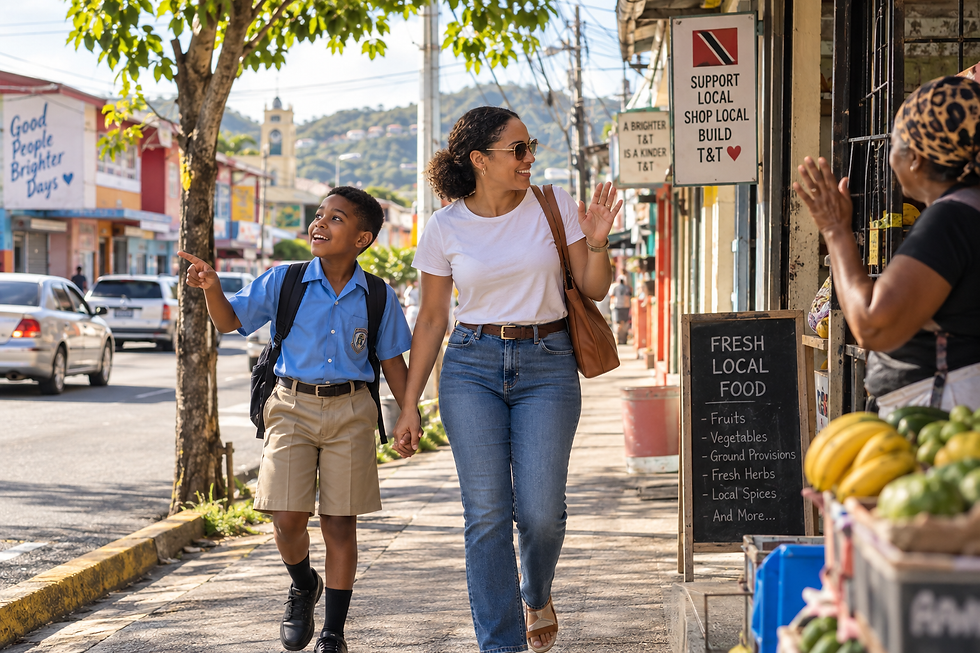
This generation of children is underexposed to a frightening level.
I first noticed it when my daughter was a toddler and I realised that her entire life could be our apartment. A small two-bedroom space with enough comforts for us. She loved Elmo, and that translated to her basically watching Elmo whenever she watched TV. Yes, I read to her. The vast range of books created for one and two-year-olds. She would visit family every now and then. But for the first four years of her life, her wandering space was small.
Because I noticed this, I made efforts to expand her horizons, have her see, experience and interact with new spaces, people and environments.
I'm not sure how many parents notice.
When we were children growing up in Tobago, there was a great level of freedom. At four, I was roaming between houses, going down to the beach, playing by the river and climbing cannons at the fort. That allowed me to really see the world. I knew which side of the road cars drove on. I knew how to buy from the shops. I knew about differences in families and how dew settled on grass in the mornings.
Now, children are so protected, and rightfully so, but their minds can become caged inside their experiences along with their bodies. And in Trinidad and Tobago, this protection did not come from nowhere. Parents are afraid.
Crime has changed how many families allow their children to move through the world. For many parents, particularly those with the means to keep their children behind gates, in cars, at supervised activities and safely indoors, allowing a young child to roam the neighbourhood is simply unthinkable. I understand it. I do it too. But there is a consequence we don't talk about enough.
Their physical worlds have become smaller, while their digital worlds have become enormous.
I often talk about television and the power of a single channel. We had two: TTT and TV6. If you wanted TV, those were your options, and because they had to cater to an entire population, the programming was varied. A child would see news, morning talk shows, cartoons, gambling, soap operas, family programmes, documentaries and whatever else was on TV. That meant we learnt by exposure. A Black girl in Tobago saw Mastana Bahar and saw difference. You encountered people, accents, music, customs, problems and ways of living thatlooked nothing like your world did and you got curious, and learnt from them.
Now we have so much power over our entertainment that we can cordon off our minds.
A child who likes SpongeBob SquarePants in 2026 literally lives in an apartment, or some other safely restricted space, and owns a device. They have the option of watching only SpongeBob for 24 hours a day, seven days a week. They only ever see, learn and speak about what they see.
Fast-forward to Standard 3.
Exams are approaching, and they are expected to read and understand content that stretches beyond the limitations of their lives so far. They are expected to write, on cue, based on prompts asking them to think critically and imagine scenarios they have never experienced or even heard of. They are lost.
My mind has been blown this year teaching Standard 3s through Form 5s for SEA English, Creative Writing and CSEC English A and B, and seeing across the board how much our children simply don't know. I've talked about stories and fairy tales before. This year, I asked a child about the experience of walking down the road.
They could not relate.
Why?
They had never done it.
I was looking at a ten-year-old child who had never walked down the road.
I don't blame them or their parents. When was the last time you walked down the road?
But it means they are growing up without understanding some of the micro-experiences that come with that. The feel of the heat under your shoes. The smell of pitch after it rains. The way you check the sky and plan for changing weather. The people you pass. The signs you notice. The little social interactions. The emotional connections. Simple, small, innate experiences that you only get by living. And when they read about these experiences, they don't always understand. This accumulated knowledge of the world is part of what educators mean when we talk about background knowledge.
That matters enormously in school.
An inference requires a child to take what a passage tells them, combine it with what they already know about life, and make a sensible judgement about something the writer has not stated directly.
But what happens when the second part is missing?
What happens when there isn't enough stored knowledge of the world to draw from?
How are our babies supposed to infer from experiences they have never had?
In SEA comprehension, only a handful of questions are purely literal. The others call for inference, interpretation and vocabulary application. They are struggling, and their teachers are right there struggling with them. And beyond an exam, life requires you to know, to some degree, how the world works.
If you think I'm exaggerating, here are some of the questions I've asked children:
"What colour is a goldfish?"
"What is a slug?"
"A snail without a shell, basically."
Blank stare.
"Do you know what a snail looks like?"
"No."
"The narrator crossed the street to avoid walking past that house. Why?"
No clue.
If I look up and decide to walk with my umbrella, what did I probably see?
No clue.
"How many legs does a duck have?"
I've had a child tell me they had never seen one.
"What's a sapodilla?"
"A story refers to Noah's Ark being crowded and wet. What does that suggest?"
They didn't understand the reference.
And I don't know if you've noticed, but our children's knowledge span is dwindling.
It's even worse if we're only talking about knowledge of local and regional things. But that's another blog.
For SEA and CSEC, children need enough knowledge of the world to make connections when they read and enough lived experience to have something to draw upon when they write.
So what do we do?
Reducing the effects of this requires deliberate intervention from parents.
Tell your children the stories of play and exploration from your childhood.
Create avenues for discovery of our food, culture, language and the things that make us unequivocally Caribbean. Take them with you sometimes. Let them see you buy something from a shop. Let them order their own food. Let them feel rain coming. Let them notice when the sky changes. Let them listen when adults tell family stories. Point out the mannerisms and situations they may miss. Ask them questions that build emotional intelligence. Take a family road trip when you can. Let them experience somewhere unfamiliar. Give them opportunities to speak to people outside their immediate circles. Let them ask questions.
And it works both ways.
As much as they should be aware of the things we were exposed to, we also need to be aware of what excites them.
Their childhood cannot look exactly like ours. Nor should it.
The world has changed. Trinidad and Tobago has changed. Many of the freedoms we had as children are freedoms responsible parents simply cannot give their children today. But we have to recognise what was being learnt inside those freedoms. Life may have shifted in such a way that it puts us in boxes.
We do not need to secure the lid.
Krys-Darcelle Dumas is the Founder and Lead Educator of Think-Top Educational Institute in St. Augustine, Trinidad. She holds a BA in English Literature with Linguistics from the University of the West Indies, has lectured part-time at UWI for seven years, and teaches English and Literature at the secondary level with the Ministry of Education. She specializes in structured literacy and Orton-Gillingham based reading intervention for children in Trinidad and the Caribbean.

